
Anúncios
Discover how to prepare for AI in interviews and adapt to the new era of smart hiring.
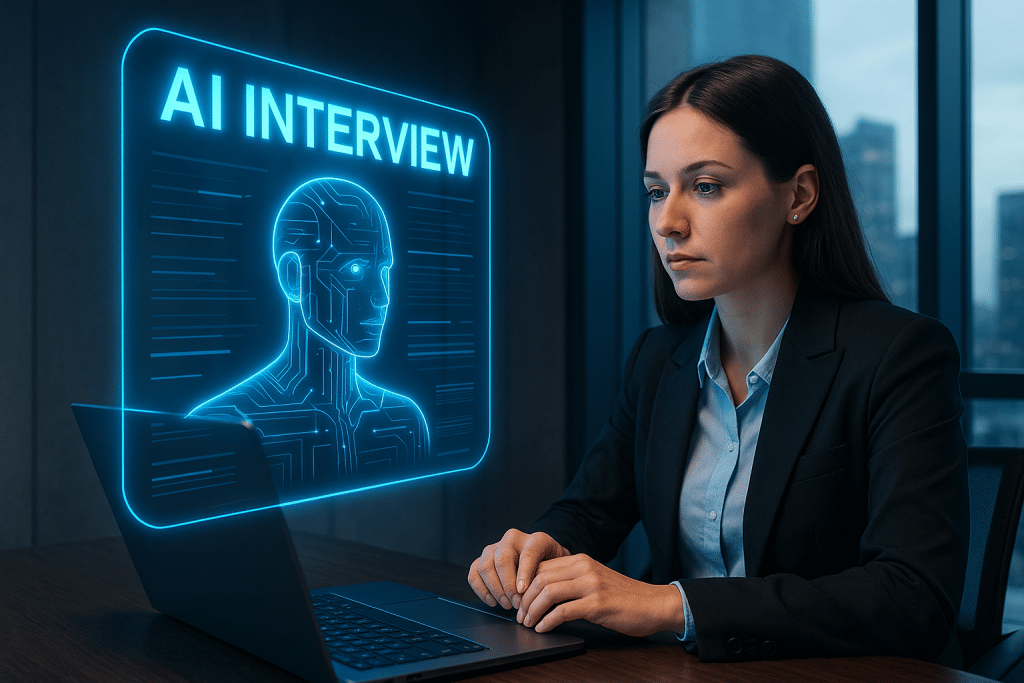
The Rise of Artificial Intelligence in Hiring
Artificial intelligence is transforming how companies recruit, evaluate, and hire talent. From résumé screening to video assessments, AI in interviews is now a standard part of modern hiring processes.
Employers use AI to analyze speech, facial expressions, and even writing tone. The goal isn’t to replace humans—but to streamline decisions and identify top candidates efficiently.
Understanding how these systems work gives you a competitive edge. Preparation today means knowing how to impress both algorithms and humans.
How AI Shapes Modern Job Interviews
In 2025, most large organizations use AI-powered tools during hiring. These systems screen résumés, rank candidates, and sometimes conduct initial interviews.
Video interview platforms analyze your words, tone, and confidence levels. Chatbots schedule meetings or test your problem-solving through simulations.
AI doesn’t judge personality—it evaluates consistency, clarity, and alignment with role requirements. Learning to navigate AI in interviews means aligning your communication style with clarity and authenticity.
Why Companies Use AI
Employers face thousands of applicants for a single role. AI saves time, reduces bias (when well-trained), and helps identify high-fit candidates faster.
It standardizes evaluations and ensures hiring decisions rely on data, not intuition alone.
However, it also introduces new challenges—misinterpretation of emotion, bias in training data, and loss of human nuance.
That’s why understanding how AI evaluates you is crucial. Preparation is no longer optional—it’s strategy.
How AI Reads Your Résumé
Before the interview, AI often screens your résumé using Applicant Tracking Systems (ATS).
To pass this digital gatekeeper:
- Use clear, keyword-rich job titles.
- Match phrasing from the job description.
- Avoid graphics, tables, or columns that confuse scanners.
- Save as a .docx or .pdf (simple formatting).
Your résumé isn’t just for recruiters—it’s for algorithms too. The first impression of AI in interviews begins long before the call.
Understanding AI Video Assessments
Many companies now use AI tools to conduct one-way video interviews. You record responses to pre-set questions within a time limit.
The AI then evaluates your performance based on metrics like tone, eye contact, pacing, and confidence.
To prepare:
- Maintain good lighting and posture.
- Smile naturally and look at the camera.
- Speak clearly and avoid monotone delivery.
The goal is not perfection but presence. Authenticity still matters—AI favors consistent and composed communication.
Practice With AI Simulations
Preparation means familiarity. Many online platforms now simulate AI in interviews, giving feedback on pacing, tone, and keyword use.
Tools like VMock or Interview Warmup (by Google) help you rehearse with AI-driven insights.
Practicing in these environments builds confidence. You’ll learn how to balance professionalism and warmth under digital observation.
Keywords and Communication
AI relies heavily on language patterns and keyword recognition. Tailor your vocabulary to the role’s description.
For example, if you’re applying for a marketing position, mention “analytics,” “ROI,” or “campaign optimization.”
Avoid jargon or buzzwords that don’t add substance. The right language increases your score with algorithms—and clarity impresses human recruiters too.
Emotional Intelligence Still Wins
While AI evaluates performance, emotional intelligence remains irreplaceable. It’s what helps you connect once you reach the human stage.
Show empathy, humility, and curiosity when engaging with people. The best professionals know how to complement technology with genuine connection.
In the age of AI in interviews, humanity becomes your greatest advantage.
Mastering Virtual Body Language
AI can detect body language cues such as posture, gestures, and facial expressions.
Maintain a relaxed yet confident presence. Avoid crossing arms or looking away frequently. Subtle nods and smiles convey engagement and confidence.
Body language influences both AI scoring and recruiter perception. Practice in front of a camera to refine your delivery.
The Importance of Voice and Tone
Your voice communicates energy, confidence, and clarity. Speak at a steady pace and vary your tone naturally.
AI tools often penalize extreme monotony or excessive filler words.
Before your interview, record yourself answering questions. Listen for clarity, tone, and rhythm. Adjust until you sound conversational, not rehearsed.
Common AI Mistakes to Avoid
Candidates often fail automated interviews for simple reasons:
- Speaking too quickly or too softly.
- Using vague answers without measurable examples.
- Poor lighting or distracting backgrounds.
- Overthinking responses, resulting in robotic delivery.
Treat the process seriously but stay natural. AI favors clear communication, not perfection.
Ethical and Privacy Considerations
AI in hiring raises valid concerns—bias, data usage, and privacy protection.
You can ask recruiters how AI tools are used, what data is stored, and whether human review follows the automated phase.
Transparency builds trust on both sides. As candidates grow more informed, ethical hiring becomes a shared responsibility.
How to Prepare Strategically
- Research the company’s AI tools. Learn what platform they use.
- Rehearse on camera. Get comfortable with timing and delivery.
- Update your résumé for algorithms. Use relevant keywords.
- Focus on storytelling. Share experiences with structure (Situation–Action–Result).
- Stay calm and confident. Energy translates even through screens.
Preparation turns uncertainty into confidence—especially when facing AI in interviews.
Blending Tech and Humanity
AI will continue to grow in hiring, but human judgment remains final. Recruiters use AI as a filter, not a replacement.
Your goal is to master both languages—the digital and the emotional.
Embrace technology as an ally, not an enemy. Those who adapt will lead the future workforce.
Continuous Learning Pays Off
The tools used in hiring evolve quickly. Stay updated on AI trends, digital communication, and emerging technologies.
Even small efforts—like taking online courses on digital literacy—can dramatically improve your interview performance.
Knowledge empowers you to approach AI-driven systems with understanding, not fear.
The Future of AI in Interviews
AI will grow smarter and more personalized. Algorithms may soon tailor questions to your experience or simulate real job scenarios.
Eventually, AI may help match candidates with roles that fit both skills and personality.
But no matter how advanced it gets, human intuition will remain irreplaceable. Authenticity and adaptability will always matter more than automation.
Final Thoughts
The future of hiring is already here, and AI in interviews is just the beginning.
Success depends on balance—combining digital readiness with emotional intelligence.
Prepare technically, present authentically, and remember: even in a world run by algorithms, people hire people.
Master the tools, refine your message, and you’ll not only pass the AI filters—you’ll stand out beyond them.